(originally posted on our Founder Makena's Substack)
Answering the age-old “what do I do?” question has always been challenging.
But figuring it out in this new world of work — post-A.I., post-COVID, where headlines blare about economic instability every day — has made it more challenging than ever before.
It’s bred a culture of career scarcity, leaving many of us feeling anxious, lost, and stuck.
Here’s the good news though: these workforce shifts aren’t entirely negative. Every major disruption is more like a double-edged sword:
- COVID accelerated solopreneurship (good), but navigating an independent career path alone can feel deeply isolating (bad).
- Remote work unlocked location independence (good), but it also broke down traditional workplace connection (bad).
- A.I. is hitting historically ‘stable’ industries like finance, tech, and consulting hard (bad), but we’re also seeing an evolution of key roles. It’s also breathing new life into non-traditional paths like trade and artisanal work. (good). In 2026, some plumbers are making more than investment bankers!
- The era of the 20-year corporate tenure is over (bad). While pivoting is scary, it’s also allowing people to build careers aligned with their real values, skills, and curiosities (good).
The second thing I want to flag, in addition to the nuance (good and bad) of these workforce shifts, is that career scarcity — a limited mindset around what’s possible — has existed since the dawn of time. (No doubt hunter and gatherers were wondering is there anything else to do besides hunt and gather?!)
Pandemic or not. A.I. or not. Career scarcity persists.
Why?
Most of us operate — often unconsciously — inside a narrow career bubble defined by parents, peers, social media feeds which tend to show us more of the same, and prestige (a.k.a. schools). We limit ourselves to just a few career path possibilities simply because it’s hard to imagine what we haven’t seen. To venture outside the bubble, you first have to know what exists beyond it.
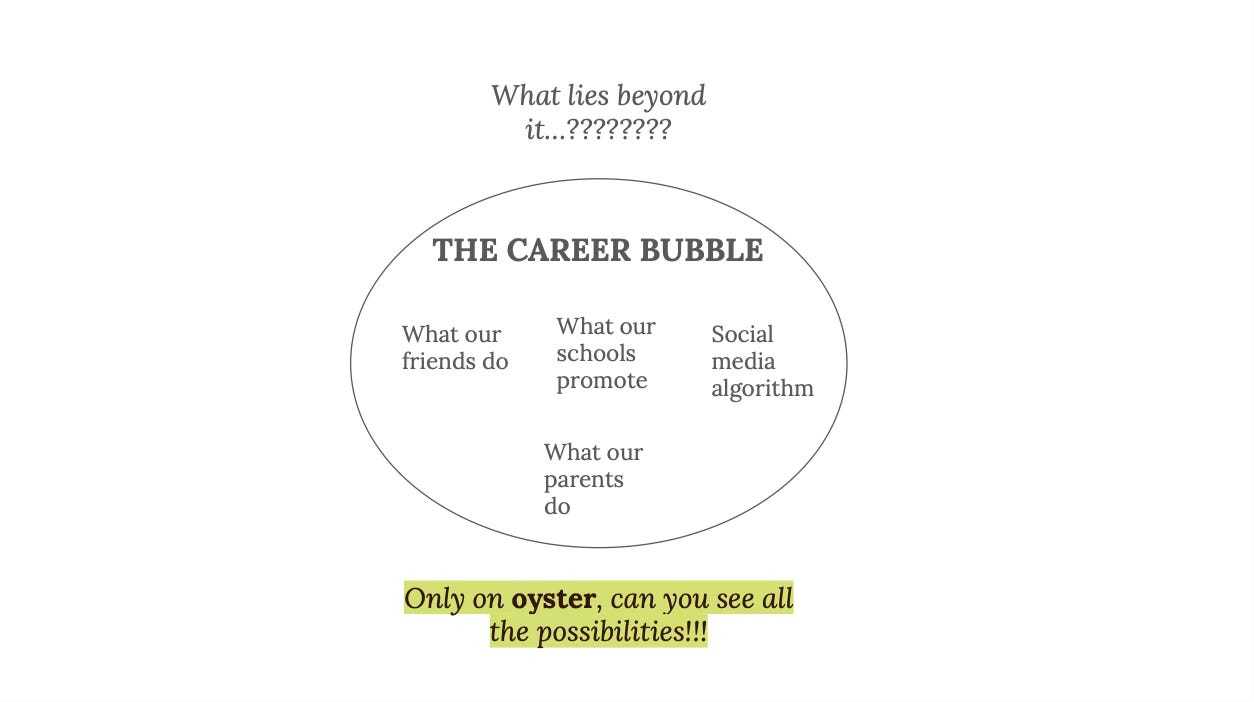
That exact challenge is why I built oyster. I built it to burst our career bubble.
Before diving into how oyster solves this, let me step back and share the personal journey that first sparked the idea…
My Career Journey
Ever since I started kindergarten, I’ve wanted to work. My parents used to joke to friends and family, “Here’s Makena. She just wants to get a job.”
To me, work represented freedom.
It meant doubling down on the subject that lit me up most instead of rotating through several subjects (math, science, art, language, history, etc.). Plus, you got paid for it! Win-win.
Business was the field that always intrigued me. Largely because both my mom and dad worked in business (*cough the bubble). Specifically, entrepreneurship and founder stories were my particular obsession. I even dressed up as Ruth Handler (Founder of Barbie) at one point:

When it came time for college, I optimized for my career:
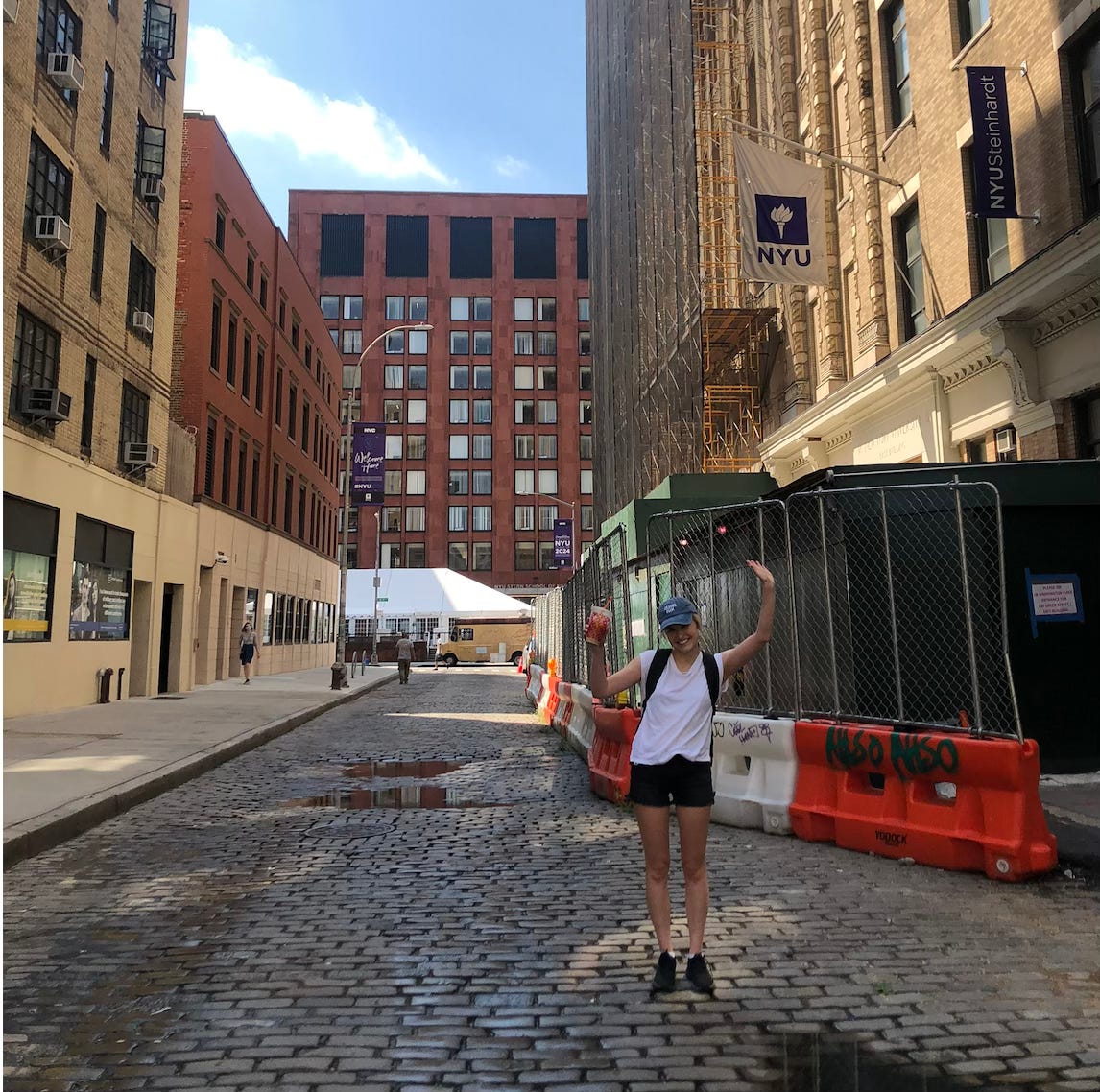
NYU Stern offered tactical business majors (Marketing and Data Science) in the heart of Manhattan, one of the largest cities in the world. The plan was clear: intern early, explore, and graduate with a full-time offer in hand.
Coming to campus with hope and hustle was one thing, but executing that plan turned out to be draining.
I arrived at NYU passionate about the creative side of business—marketing, entrepreneurship, and developing new products (a field I didn’t yet know was called “innovation”).
But inside Stern, the dominant narrative boiled down to two paths: finance or consulting. If you were lucky, PE or VC.Tech was an outlier path, but it was respected because it paid well. Marketing was another outlier path, but less respected. Here is a Venn diagram that represents the ‘sea’ of possibilities:
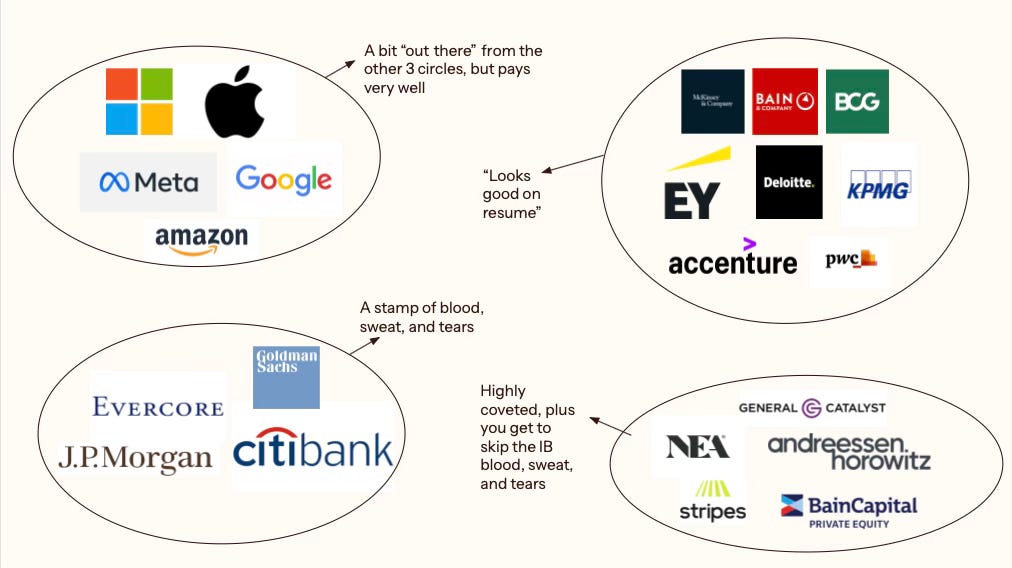
Despite entering college with an abundant mindset about career possibilities, my world quickly shrunk to those two predominant paths – finance and consulting – and the same ten companies everyone competed for.
Stern is infamous for students wearing suits to class starting sophomore year to land coveted junior-year internships. I fell right into that trap: reading Case in Point in my free time, remaining in a perpetual ‘recruiting’ mindset, and wearing a suit to class.
Was figuring out my career fun? Was it exciting? Was it easy?
No.
It was wildly stressful, and I lost two years of my college experience to that anxiety.
Getting through the brutal superday at a growth equity firm called Stripes— my absolute dream job at the time — only to be rejected was one of the lowest moments I’ve ever hit.
Having survived much harder personal times before, looking back still leaves me with a sense of shock over how those finance internship rejections at age 20–21 absolutely broke me. Just destroyed.
Perhaps because unlike other life heartbreaks, pointing a finger at anyone else wasn’t an option; I took 100% of the blame. With such a narrow list of opportunities to begin with, each rejection felt catastrophic like holding ten balloons that I was putting so much pressure on, and watching them pop until no balloon remained.
Deep down, I knew that finance and large consulting firm culture wasn’t a true fit for me. But my entire recruiting approach was reactive. Opportunities were limited to on-campus recruiters and a Handshake feed that grew uninspiring and depressing with every offer I failed to get.
My First Job
I eventually came out of the finance and Big 4 consulting haze, Ogilvy became the top choice, followed by a large IT company called Capgemini. Both firms recruited on campus.
When the pandemic hit, a paid junior summer internship at Ogilvy turned into an unpaid remote fellowship. Seeing firsthand how vulnerable traditional marketing roles are during an economic downturn prompted me to gravitate towards Capgemini when they offered me a full-time job offer.
While I had doubts about Capgemini, I signed my offer with confidence after overhearing a girl in the school café raving about an interview she was doing with a small innovation firm that was recently acquired by Capgemini:
“They had me brainstorm new products and services for Subway! It was so fun and challenging!”
The firm’s unique name stuck immediately. A quick lookup sparked genuine excitement: the company’s approach to innovation combined commercial strategy with creative magic, forecasting industry trends, and inventing new business lines.
I saw it as a fallback option: if I didn’t like the Capgemini role, I would pivot to the acquired innovation firm. I put that innovation firm right on my vision board and read the book about the company published by the founder called ‘How to Kill a Unicorn’ (grabs your attention, right?!)
Day 1 at Capgemini confirmed the initial fear: the role was completely wrong. The HR pitch of “creative, strategic consulting” turned out to be rigid IT implementation and project management. For some, that’s a dream job; for me, it felt soul-crushing. I couldn’t help but this: Is this what work is supposed to be? This can’t be it.
I wanted to feel lit up, but my light was burning out.
A few months into the job, I started cold-outreaching internally for coffee chats with people at that innovation firm. Naysayers warned me it would look bad on my resume to switch roles within a year (even within the same company). But learning and engaging work to me were the ultimate career currencies. I pushed through and made the pivot.
To this day, it’s one of the best decisions I have ever made.
Still, could it have been easier? Could I have learned about that innovation firm or others like it much sooner?
The Mid-Career Conundrum
After a few years, a common pivot for consultants is to move “in-house” or in an industry they love. For me, it was media and entertainment.
Yet again, I hit the exact same wall: Where do you even start? What organizations exist beyond the obvious? What roles are right for me? What teams?
I knew the massive giants — Disney, Netflix, NBCUniversal. But what else was out there? I spent exhausting hours manually cross-referencing startups on Crunchbase, Built In, and CES directories.
To validate which firms to apply to I cold messaged media professionals on LinkedIn. While it yielded some success, LinkedIn wasn’t built for genuine, exploratory career conversations; it felt performative and transactional.
Ultimately through those coffee chat conversations, I realized I wanted out of corporate entirely and decided to opt for the more entrepreneurial route to launch oyster and write screenplays. I figured if not now, when?
But what I came to find is that solopreneurship and early-stage founding becomes isolating very quickly. I knew there were others out there like me pursuing similar paths but finding them felt entirely left to chance.
Looking back at my career journey, that seemed to be the recurring question, keeping me up at night: What if navigating your career relied less on luck?
- No more hoping you bump into the right person at a networking event.
- No more relying on overhearing a cool company name in a café.
- No more limiting your ambitions to whoever recruits at your school.
- No more screaming into the void on LinkedIn, hoping the right people find it.
- No more waiting for a friend to drop an invite to a WhatsApp group for female founders like you.
What if careers were more of a science instead?
- Targeted Discovery: Typing your interests and skills into a search bar to discover organizations, which you can then filter by location, team size, and structure (startup, non-profit, enterprise).
- Niche Career Communities: Communities for each specific career trajectory (from Female Tech Pre-Seed Founders to Independent Screenwriters) with organized message threads to prevent you from feeling guilty about missing 100 WhatsApp messages a day: dedicated channels for resources, Q&As, collaboration requests, and daily musings.
- Candid 1:1 Coffee Chats: Being able to connect directly with people a few steps ahead of where you want to be. An environment built on reciprocal conversations where people openly share their career experiences and lessons learned without a $1,000 paywall for 20 minutes of an executives’ time. (Not to mention, it’s typically the people just a year or two above you not the highest up executive that has the most actionable, helpful advice.)
What if finding a career wasn’t about squeezing yourself into whatever job posting happens to pop up on your feed? What if it started with what actually excites you, what you’re great at, and building genuine connections with people in the spaces you want to enter?
THAT’S where the search should begin.
In today’s black box of job applications, leading with real skill, curiosity, and authentic relationships is the only way to stand out and get hired.
That’s why I created oyster
My app oyster surfaces the right organizations, people, and communities aligned with your specific trajectory — all in one place. No more piecing together fragmented information across Reddit threads, WhatsApp groups, Glassdoor reviews, and TikTok career influencers.
We recognize a fundamental truth: as you evolve, your career should evolve too. Today you might value compensation; five years from now it might be impact or flexibility.
The problem isn’t a lack of opportunities. In a world of millions of organizations and billions of professionals, your ideal fit exists. Finding it is the hard part.
oyster acts as a career navigator for everyone across every generation:
- The parent re-entering the workforce after raising children.
- The retiree who misses the structure of work and wants a purposeful next chapter.
- The professional taking a sabbatical, recovering from burnout, or reskilling for a new industry.
Celebrating the Multi-Dimensional You
We empower you to display everything you do, including side ventures, contract work, and hobbies. If you don’t have a traditional corporate background, your project work still counts. We offer ‘Project’ cards!
You can also answer fun career prompts like “Favorite book,” “Best career advice you’ve received,” or “A skill you’re currently learning.” See my profile here :)
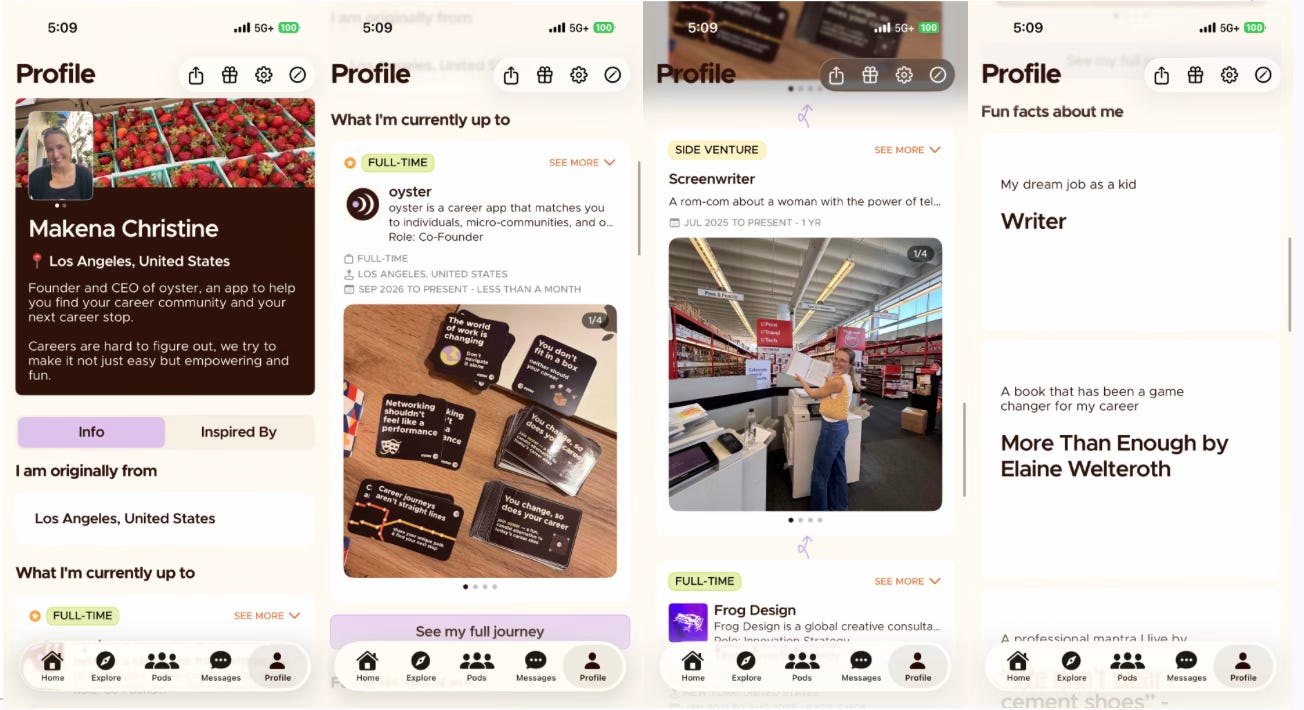
Some might argue this makes us less professional than LinkedIn, but people are already using LinkedIn to tie personal engagement photos or school drop-offs back to B2B sales lessons just to get reach.
This brings us to another key difference between oyster and other social platforms like LinkedIn: we are a social platform intentionally NOT designed for likes or reach. There are no public follower counts, no vanity metrics, and no noisy public/global feed. You post only inside your accepted career communities.
oyster is a space focused on discovery, exploration, and validation. Crucially, we take into account where you have been, but also where you want to be. (LinkedIn only optimizes for what you have already done and are doing).
Our goal is simple: make career navigation easy, exciting, and empowering.We want to help you take back CONTROL of your trajectory and empower you to dream big.
You can browse organizations and professionals across 26 industries ranging from Aerospace to Anthropology. For each industry, we will also soon spotlight top books, podcasts, emerging roles, and trending skill sets.
oyster is My ‘Why’
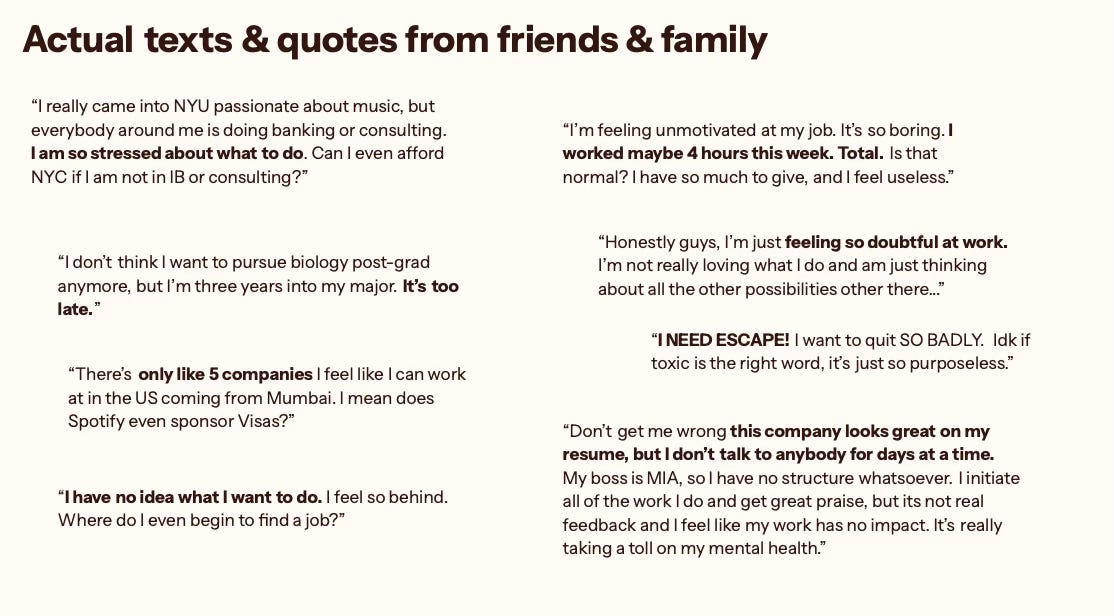
oyster – bringing a sense of joy to careers (because I don’t think it ever existed to begin with) – is my lifelong mission. I see signs of oyster everywhere, everyday: the person next to me saying how stuck they are in their field, the students who tell me LinkedIn feels ‘performative’ and ‘a necessary evil’, Stanley Hudson from The Office, so many books!: Exit Interview, More than Enough, Tryhard. Text messages from friends like this:
Navigating your career should be exhilarating, NOT suffocating.
Incredible roles, fulfilling paths, and hidden-gem companies ARE out there. The difficult search is just what typically stops people in their tracks.
Finding where you belong should NOT be the hardest part of the journey.
Technology and specifically social media are incredibly powerful tools for career discovery and community. oyster is going to be the first company in the world putting them to good use.
We spend a third of our lives at work, and at oyster, we refuse to accept “stuckness” or the Sunday Scaries as the default setting.
oyster is on a mission to change that and show you that the right people and places exist for your unique, ever-evolving journey in this world with billions of professionals and millions of organizations. We will be there with you every step of the way.
So, please SIGN UP, build your profile, and spread the word of oyster!!!! Here’s the link to us in the App Store:
https://apps.apple.com/us/app/oyster-career-community/id6782741944
Lastly, thankful to all of the cheerleaders who have supported thus far! Ex. colleagues, friends, family, Substack communities, NYU grad students, mentors, people I met walking down the street!
This is just the beginning…!!!!
P.S. I’d love to hear about your career journey. Please DM if you’d like to chat! Always around.
-Makena