

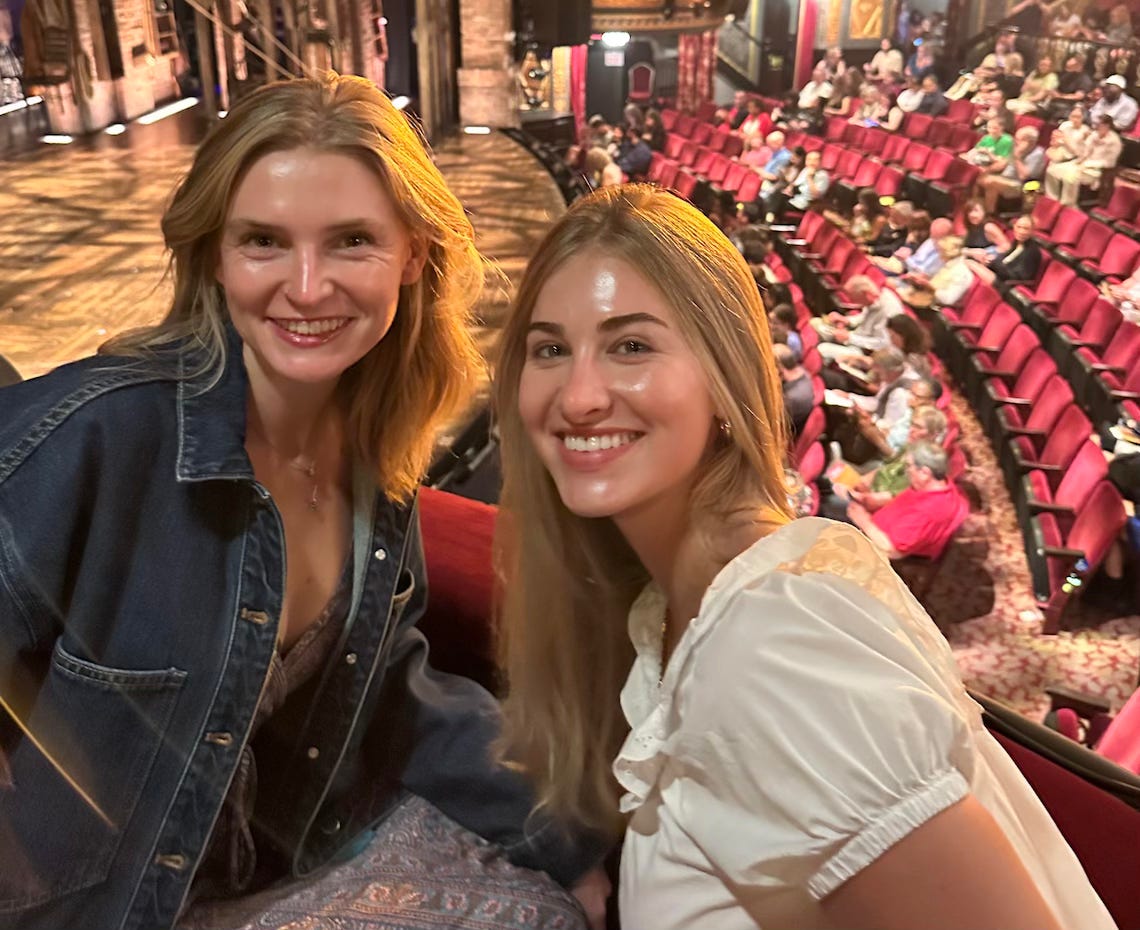
Name: Samantha (Sammi) Schofield (^pictured left)
Job: Development Producer in TV & Film
Current career status: Transitioned from Vice TV to a boutique production company; navigating the corporate and creative world of development in unscripted sports media.
Location: Brooklyn, NY
Link to Sammi’s oyster profile
THE DREAM JOB
Makena: What was your dream job as a kid?
Sammi: A psychologist.
Growing up, I didn’t really know what was possible in the media world. Throughout high school, I didn’t take any media classes. I didtake AP Psychology. Even when I went to NYU, I fully expected to major in psychology!
Makena: Psychology to media is a pretty big pivot! Although I guess psych is transferable to pretty much every career field. What prompted the pivot?
Sammi: During my freshman year, I took a creative writing course. My professor pointed out that my writing style was distinctly, “cinematic”.
Makena: That’s the best compliment ever.
Sammi: That nudge from my professor is what led me to apply to Tisch School of the Arts, which officially got me into the film and TV world. Being at Tisch, surrounded by people in the creative arts, was super inspiring. (Especially as a big Broadway fan!)
Makena: There’s so much you can do within film & TV. How did you figure out what roles to pursue?
Sammi: I quickly realized I didn’t want to be on stage or behind a camera as a director or DP. While I was exploring Tisch’s offerings, I realized producing was a huge subset of the industry. I’m naturally an organized, task-driven, problem-solving person – producing fits that skillset perfectly.
THE ORIGIN STORY
Makena: Walk me through how you landed your first job experience.
Sammi: During my sophomore year, I was just mass applying on Indeed and whatever job boards that offered internship programs, associate producer roles, or assistant positions in scripted and unscripted development. People typically start there or doing production assistant (PA) gigs on set to understand how productions actually run. That mass application approach is how I found my first internship at Vice.
Makena: COVID was a really weird and challenging time to start working in, especially in the film/tv production world. What was that like?
Sammi: So different from my parents who worked standard 9-to-5 corporate jobs in an office! (Haha).
Figuring out how to navigate remote work was tricky. It made networking and feeling like part of a team difficult. When you only interact with one or two people on your immediate team in an online setting, it’s hard to know if you’re on the right track or doing well.
Eventually, things started moving back to in-person. Vice went to a hybrid model, and at my current company, we’re in the office three to four days a week. Originally, I thought, “Oh I can totally do all of this from home.” But being in the office brings a level of communication and personable connection you just can’t replicate over Zoom. Those casual banter moments grabbing a coffee help form much better creative relationships.
Makena: You experienced a pretty major career transition during your time at Vice.
Sammi: Yes, Vice went through massive restructurings and eventually filed for bankruptcy while I was working there.
Makena: A bit more intense than your classic layoff. How did you navigate that time period?
Sammi: I ended up staying on until February of 2024. I was quite surprised I held on that long after multiple rounds of layoffs.
When my time there ended, I was unemployed for a few months trying to figure out my next move. I applied everywhere: associate producer roles, PA jobs, social media companies, ad agencies.
Then in August 2024, I got a message on LinkedIn from the former President of TV at Vice, who I had met during my internship. I had to pitch a TV show idea to him and the executive team, and he liked it. It’s funny because I think I stuck out more in his brain for that pitch than anything I did as a full-time employee because we never really crossed paths again.
He had moved to a new production company at this point and basically DMed me on LinkedIn saying, “If you’re looking for a job, I’d love to have you on our development team.”
Makena: I mean this is truly how opportunities unfold in the real world of work. How incredible.
Sammi: It made me realize that in this industry, you just need that one key connection or champion to push you forward. This guy has been in the media industry through so many evolutions and at all different capacities. He’s an incredible mentor who advocates heavily for people he believes in.
THE DAY-TO-DAY REALITY
Makena: What does your day-to-day work look like and what skills are you relying on the most?
Sammi: I work on a small team alongside three bosses, collaborating with our Canadian office.
The role requires a strong mix of interpersonal and also technical skills. I’d say the top 3 are:
- Cold Outreach & Advocacy: In this industry, you have to be a people person who isn’t afraid to make a cold call or pitch an idea passionately. If you care about a project, you have to be able to sell it in a way that gets other people engaged.
- Development & Sourcing: A huge chunk of the job is searching for new stories, reaching out to journalists, connecting with other production companies, talent, and reaching out to people on social media.
- Visual Deck Design: Pitch decks sell shows. Many development teams, especially lean ones like mine, don’t hire graphic designers anymore, so as a development producer, you have to write the copy and design the deck. Getting big points across visually in a concise way (using Canva or Photoshop) is crucial. A great title and visual poster reference can help get a project greenlight.
Makena: What are your favorite aspects of the job?
Sammi: I actually love designing decks. I get to push myself creatively in a way that is entirely up to me. When I started working, I didn’t have a lot of design skills, so it’s cool to see my improvement over the last two years.
I also love the travel opportunities—I’ve gone to Monaco and Australia for shoots, interviewed legendary figures like Mark Messier, and met world-class athletes. There’s a lot of “I can’t believe this is my job” moments, which doesn’t make work feel like something I have to get done.
Makena: That’s the dream – when you find that feeling. What parts of the job are more challenging?
Sammi: Pitching. I’ve had public speaking anxiety since I was a kid. It’s not even the pitch, it’s the lead-up to pitches which always gives me terrible nerves – I can’t eat for the whole day. I get sweaty hands, shaking, the whole deal. And I do them all the time! It’s just the anticipation beforehand that is rough.
Makena: This is extremely relatable. I get the same way when presenting. You’d think our bodies would learn: “Hello, we’ve done this before and it went great!”
Switching topics, how is your work-life balance?
Sammi: It’s pretty good, especially compared to freelance set life which can include weekend days of work or my friends in corporate finance. Because I’m in a more structured 9-to-5 media role, I have consistent hours most of the time with occasional set travel.
Media is an industry that operates in seasonal waves: September through November and April through June can be more busy and intense, but mid-summer and the winter holidays slow down significantly.
Makena: What has been your favorite project so far?
Sammi: The documentary we did for Netflix, Scotty James: Pipe Dream. It was one of the first projects my boss brought me onto. Instead of the typical process of selling a pitch to a streamer before shooting, Scotty was competing in his fifth Olympics that coming February, so we started shooting immediately on our own.
I got to travel to Monaco and Australia. I also worked heavily in the editing suite pulling soundbites, helping piece the narrative together and shaping it with our showrunner. Seeing it air on Netflix with my name on the credits was a huge dream-come-true moment.
Makena: I bet! Congratulations. It’s incredible that you got to be a part of the project from start to finish from development to production and post-production.
Sammi: Yes, normally I focus more on ‘pre’ work, so I help sell the project and then typically see it when it airs. This was different. Because I was there throughout the whole process, by the time we were in the editing room, I felt like I understood Scotty, his story, and what we were trying to tell. I think it came together really nicely.
THE HUMAN SIDE
Makena: What is the dynamic like working on a small team? Talk to me about the pros and cons.
Sammi: Working on a small team means wearing a lot of hats and having direct access to senior decision-makers without having to deal with the corporate politics that tend to come with working at a larger company. For example, there’s no need to set up a meeting in advance, if someone is free and you want their thoughts, a quick Slack message like “Hey, do you have 20 minutes?” will do.
However, because everyone else on my immediate team is above me, I don’t have a direct peer at my level within the company to casually bounce ideas off of. So, everything always has to be a bit more…
Makena: Polished.
Sammi: Yes.
Makena: Do you have a peer community elsewhere?
Sammi: We share an office space with a soccer company where there are people at my career stage to socialize with. I also stay closely connected with my group of NYU film friends. Most of them went the indie creative/ freelance route, whereas I took the more corporate media path. Reconnecting with them gives me a great balance between the commercial creative world and the emerging indie space.
Makena: Do you have any side ventures or time for hobbies?
Sammi: I go to a lot of Broadway shows. I enjoy analyzing them!
Oh, this is kind of fun – one of my good friends is one of the most creative people I know. For her birthday last year she wrote a play and we performed it. It was ‘A Christmas Pageant’. I produced that. We did a full table read, casting, everything.
Makena: That sounds SO fun! I don’t think it gets better than ‘Christmas Pageant’.
Sammi: We might do another.
Makena: Oh my god, please let me know!
THE FUTURE & ADVICE
Makena: I know you’re really early in your career, but where do you see your career evolving?
Sammi: I want to continue establishing myself in the sports and documentary space. My goal is to build a body of work where my track record and name hold trust, allowing me to independently pitch and greenlight projects.
Seeing my bosses and the people above me, I’ve realized how powerful and important an established track record is. Many of them started young, and now their peers hold executive positions at places like Disney and NBCU. I hope to establish that same trust and those lasting relationships with the peers at my level today.
Makena: What excites you about the future of media?
Sammi: In terms of industry trends, it’s exciting to see social media creators bridging the gap into long-form television. While shrinking attention spans is concerning and I hope not to see content getting shorter and shorter, expanding digital talent – creators you love – into longer form TV makes sense and opens up cool production possibilities.
Makena: What advice would you give to someone trying to break into TV and film production?
Sammi:
- Show Up to Local Events: In every city there is a media hub, so I recommend you find it. You don’t need to go to every networking event, but meeting just one or two right people can help open major doors.
- Build a PA Starter Kit: Everyone is always looking for a reliable Production Assistant (PA). You don’t need to know everything on day one, but be sure to carry tape, Sharpies, extra markers, and safety pins. It sounds silly but people notice that level of preparedness.
- Ask Questions on Set: Don’t be afraid to talk to people. Ask producers and crew members, “How did you get into this?” and “What does your day-to-day look like? That’s what I did, and it has helped me navigate my own career.
- Master the Business Etiquette: Focus on learning best business practices like how to define action items in calls. It can be easy to just talk about an idea for two hours, but knowing how to push the ball forward on a project and redirect a conversation is a critical skill. Also, film & TV is fundamentally a relationship-driven business based on reciprocity and continuously showing up for people. I’ve seen firsthand how there’s a lot of taking meetings and doing favors because you know down the line someone will hand it back to you.
Makena: Any newsletter, podcast, or book recommendations for people interested in pursuing a career in media?
Sammi:
- Media Mavens: An invite-only email network for women in media that connects members directly to job opportunities.
- Sports Business Journal: Great for staying up to date on sports media trends: https://www.sportsbusinessjournal.com/
- Cynopsis: Excellent for industry insights: https://www.cynopsis.com/
Makena: Final question. Favorite Broadway show?
Sammi: Hamilton!

