
Why on earth would someone more senior take a few minutes to talk to me for free?
This was the number one question we got in our oyster focus groups and interviews. It’s a fair, valid question. Look, if these senior executives really wanted to be compensated, they could go on Guidepoint, AlphaSights, MasterClass, or any of the other platforms out there where people can pay thousands of dollars for an hour of conversation. But those transactional conversations rarely lead anywhere. And besides, who said that being of a certain age or having an established media platform and net worth automatically qualifies someone as an expert?
Here’s the thing too: the people most valuable to your career usually aren’t even the ones most senior — they’re the ones just a step or two ahead of where you want to be. That also makes them more willing to talk, because they remember exactly what it was like to be in your position; they were just there.
At oyster, we believe everyone has a career story worth sharing — whether you’re an intern, analyst, associate, manager, director, or VP. That’s true whether you’re actively looking to pivot, or you assume your work is too niche or ordinary to be interesting. There’s always someone who will find your current and past career experience genuinely valuable.
Three reasons someone more senior than you would want to chat with you on oyster
1. The Intrinsic Reward: The Joy of Paying it Forward
People fundamentally like talking about themselves including their career journeys, experiences, and lessons learned. Remove the pressure of a job ask, keep it at less than 30 minutes, and focus purely on gathering insight, and you’ll find that most people are happy to chat. It also takes the pressure off of you, and facilitates a conversation that flows.
- Proof-is-in-the-pudding: Our founder's personal experience yielded an 80% hit rate when reaching out to senior executives for 20–30 minute exploratory coffee chats proof that the appetite for conversation is there as long as the outreach is thoughtful It has to come from a place of genuine curiosity, be low-lift (a short ask, at a time and place that works for them), and carry no strings attached.
- It’s in the oyster design: To ensure each chat is not transactional (rather the purpose is exploration), oyster gives users recommended prompts (e.g., "Can you tell me about your favorite project? What skill sets were you using day-to-day?"). Our UX/UI, mission, and community further fosters a space of reciprocal interactions, exploration, curiosity, and candor.
2. The Social Reward: The Pearl Progression System
Forget the vanity of follower counts. oyster uses a Pearl Progression badging system — mirroring the integrity of a two-way review system like Airbnb’s — to recognize and reward people for sharing their career experience and advice.
Every 20-minute chat rated 4 or 5 pearls earns you a pearl, and certain pearl counts unlock badges that display on your profile. Over time, these tiers mark you as a trusted Lighthouse in the oyster community.
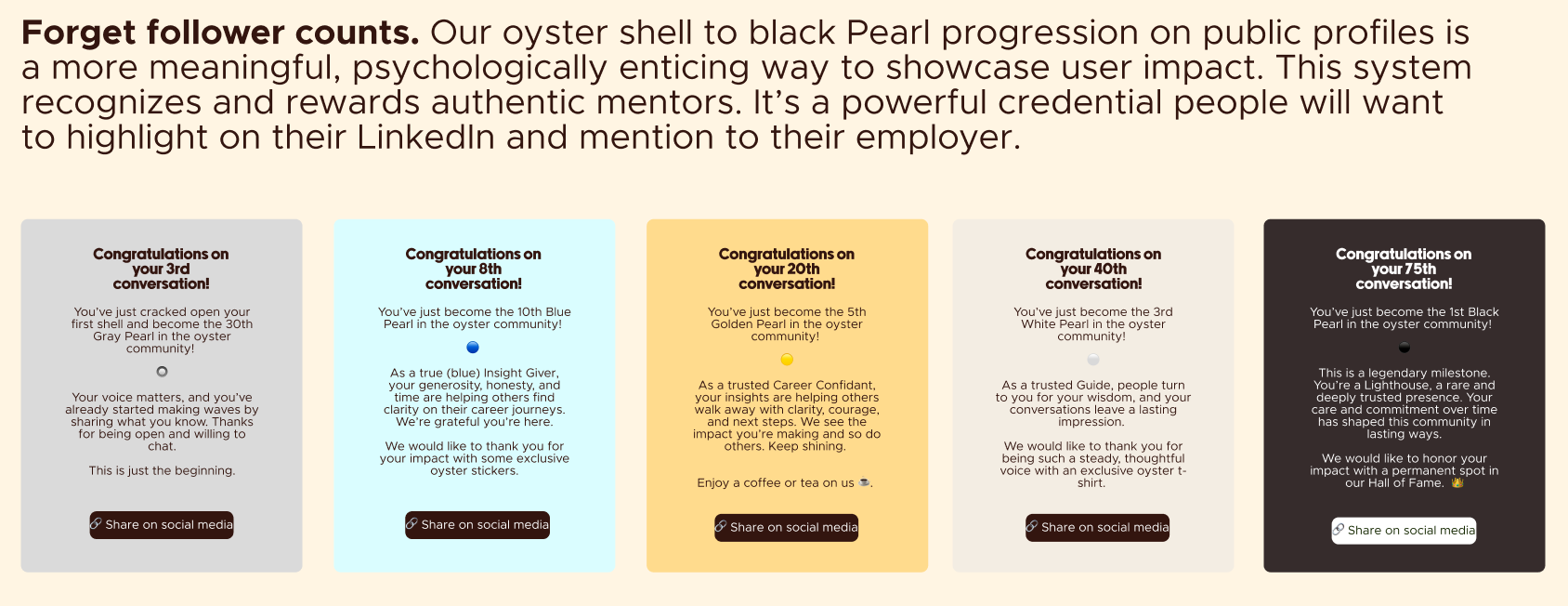
Down the line: this verified activity is, almost as a side effect, organically building a high-quality talent pipeline — one that organizations may come to see as valuable currency, worth recognizing and rewarding.
For beta users: enjoy exclusive early perks like stickers, T-shirts, and coffee gift cards.
3. The Reciprocal Reward: Mutual Gains
We use proprietary AI matching not just to pair you with people who need your advice, but with people who might also have something to offer you.
We track what you’re hoping to gain from oyster e.g. knowledge about a new tech stack, collaborators for a side hustle, and so on. Our system strategically connects you with people who meet that need, whether that’s a younger professional with platform expertise or a potential collaborator in an adjacent field.
Just look at George Russell’s outreach to Toto Wolff.
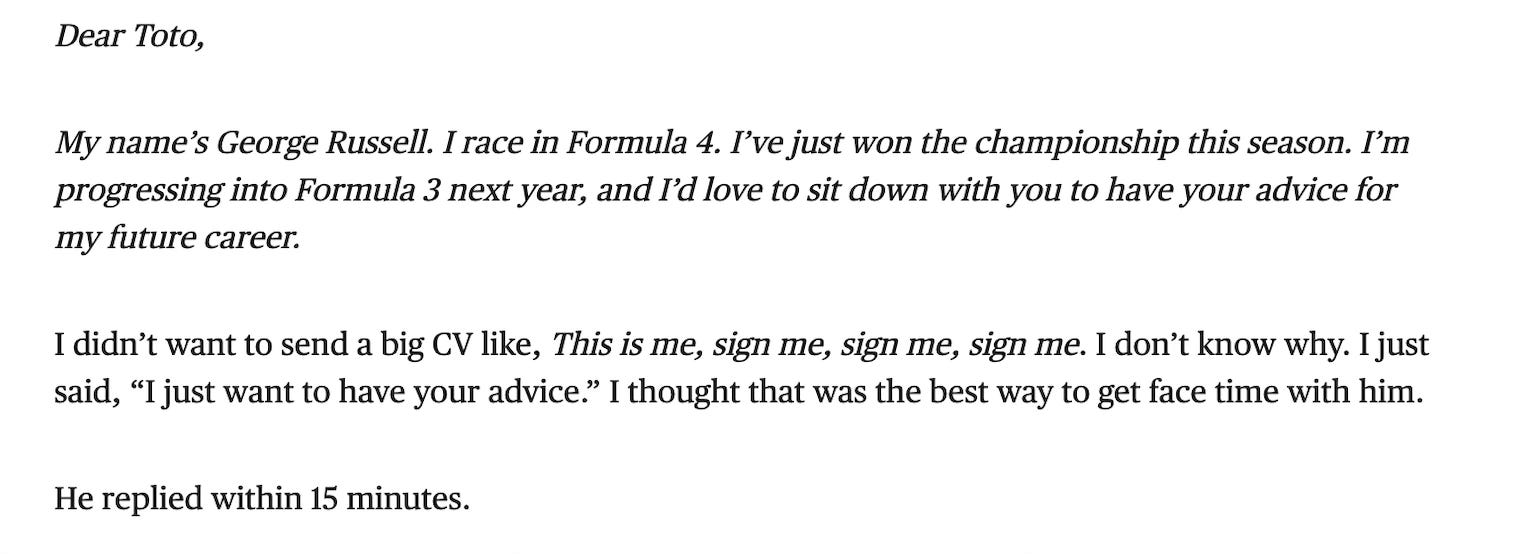
As you can see, George came from a genuine place of wanting to learn and on Toto’s end, the conversation may have doubled as an informal, low-pressure way to vet a potential future addition to his team. It was a win-win. Intent matters. Paying it forward feels good. And there can be something in it for the more senior person too, from finding a new valuable collaborator to insight on the latest tools and trends.
The key takeaway
The truth is, high-value career conversations — the ones that lead to real insight, opportunities, and a fresh perspective — are already happening. The problem is that too often the vast majority of people are relying on cold, tired, transactional networking strategies that produce unpredictable and often poor results.
oyster changes that. We’ve intentionally designed the platform to manufacture serendipity, making candid, high-impact connection a systematic occurrence that feels like a win-win. The true incentive is simple: oyster makes helping others feel good, gives you tangible recognition, and ensures that the act of giving also results in unexpected opportunities for receiving.